
"...And Then There Were None": Eric Frank Russell's 1951 Satire of Power
In June 1951, a British writer published a story in which a mighty ship from Earth lands on a lost colony and is defeated without a shot being fired. The colonists' weapons were a shrug, a slogan and an economy of favours. Seventy-five years on, Eric Frank Russell's satire is still passed from reader to reader.
The science fiction magazines of the early 1950s were full of empires, fleets and conquests. In the June 1951 issue of Astounding Science Fiction, Eric Frank Russell turned that furniture upside down. His story "...And Then There Were None" sends a great ship from Earth, full of officials and soldiers, to reclaim a forgotten colony, and lets it lose, one crew member at a time, to people who simply refuse to be ruled. The Encyclopedia of Science Fiction calls it a "fine pacifist satire." Readers have kept it in circulation ever since, and it belongs on our timeline's 1950s, beside the decade's other great arguments in story form, such as "The Cold Equations" from the same magazine three years later.
The Writer
Russell was born on January 6, 1905, near Sandhurst in Berkshire, where his father was an instructor at the Royal Military College. He became a science fiction fan, and in 1934, living near Liverpool, he met a fellow reader, Leslie J. Johnson, who encouraged him to write. Their joint novella "Seeker of Tomorrow" appeared in Astounding Stories in July 1937. Russell's first novel, Sinister Barrier, was the cover story of the first issue of Unknown, Astounding's fantasy companion, in May 1939.
Although he was British, Russell wrote mostly for American magazines, in an easy, wisecracking style that owed something to American hard-boiled detective fiction, and many readers assumed he was American. He was also the British representative of the Fortean Society, devoted to the strange and unexplained phenomena collected by Charles Fort, and wrote non-fiction on Fortean subjects. A favourite theme ran through his fiction: a single resourceful human, or a small group, outwitting a huge and ponderous bureaucracy. Much of his fiction first appeared in Astounding under its editor, John W. Campbell.
The Story
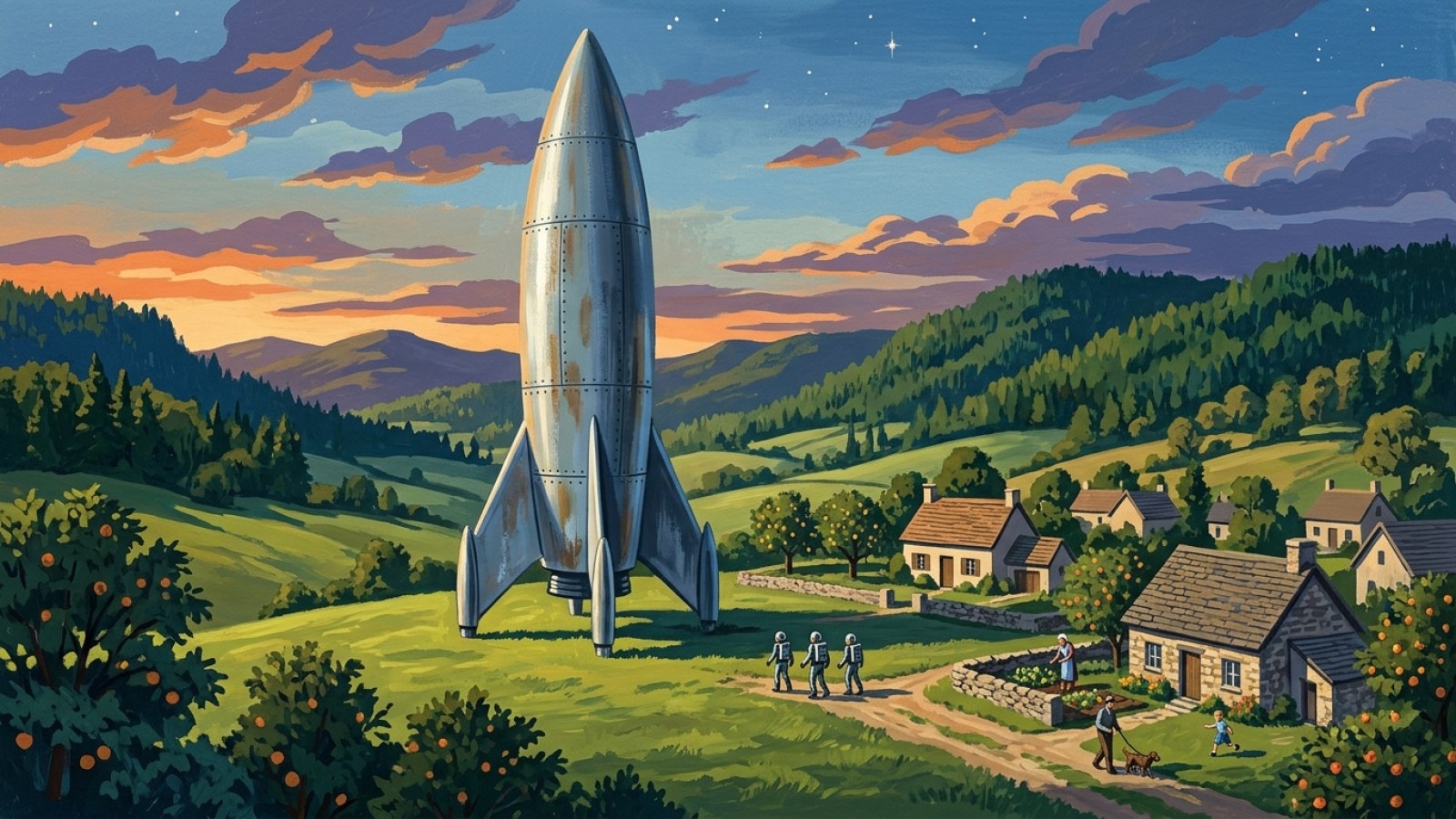
"...And Then There Were None" is set after the Great Explosion, the period when faster-than-light travel let groups of people leave Earth and settle the galaxy, each on a world of its own. Centuries later, Earth sends a ship to bring the scattered colonies back under its rule. On one planet its officers find no government, no army and no money. The settlers call themselves Gands, after Gandhi, and practise a form of passive resistance summed up in a slogan: "Freedom – I won't!" Their other watchword is "Myob!": mind your own business.
The Gands run their economy on obligations, called "obs". Do someone a service and you "lay an ob" on them; they "kill the ob" by returning the favour. Orders mean nothing to them. Nobody fights the visitors, and nobody obeys them either. Because the planet is plainly not hostile, the ship's officials have to allow shore leave, and the crew start to meet the Gands one by one. Many find reasons to stay. The officers realise they must get the ship back into space before they lose so many people that it can never fly again, and the story's title tells you how the arithmetic goes.
After 1951
Russell later built the story into a longer book. The Great Explosion, published in London in 1962, follows the same Earth ship to several colonies, each a satire of a different way of life, and ends with the visit to the Gands. In 1985 the novel was named to the Prometheus Hall of Fame, an award for fiction about liberty. Russell had already won the first Hugo Award for Best Short Story in 1955, for his comic tale "Allamagoosa". He died on February 28, 1978, and in 2000 he was inducted into the Science Fiction and Fantasy Hall of Fame.
The story has led a long second life outside the magazines, passed from reader to reader and shared online for its picture of a society that runs on trust and the refusal to obey. It sits at an interesting point on the timeline. The pulps of the 1920s and 1930s had taught readers to expect ray guns and conquest. Russell used the same props to ask a quieter question: what happens to power when nobody accepts it? The question has not dated, and neither has the joke.
