
Quatermass and the Pit: Nigel Kneale's Martian Ghosts Under London
When London excavators uncover an impossible object beneath Hobbs Lane, humanity's violent prehistory is violently unearthed. Nigel Kneale's masterpiece connects our primal fears to an ancient alien influence, revealing the darkness within ourselves.
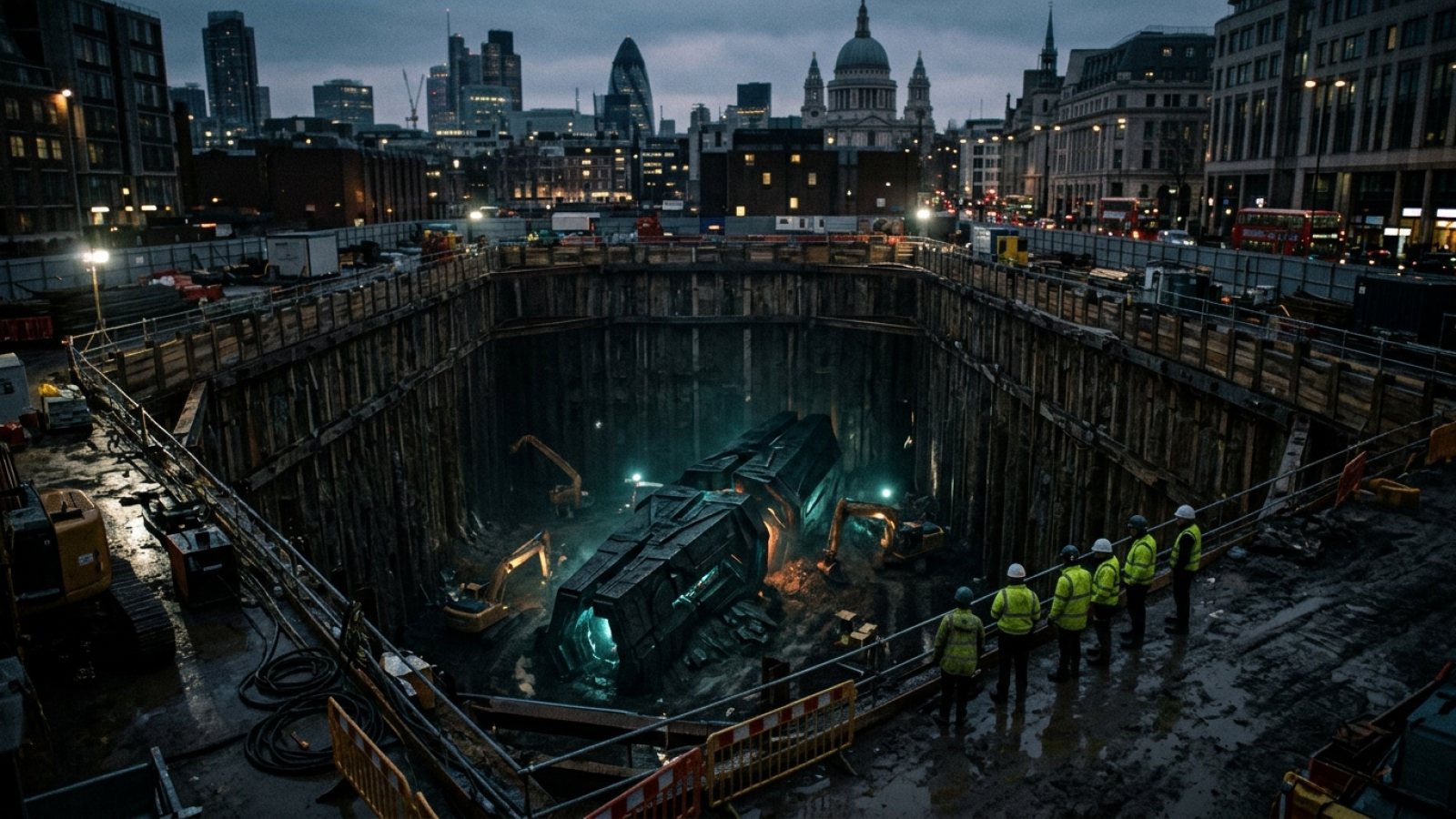
The noise began subtly, a faint, rhythmic thrumming from the depths of the Earth, before manifesting as a tangible psychic force. For the construction workers extending London's Hobbs Lane Underground line in 1958, the discovery of ancient human bones was merely an archaeological curiosity. But what came next, buried deeper still beneath millions of years of rock and clay, was an object that would rewrite humanity's prehistory and unleash the ghosts of its alien origins: Nigel Kneale’s chilling, cerebral, and utterly essential Quatermass and the Pit.
Originally broadcast as a six-part BBC serial in 1958-59, following the groundbreaking success of The Quatermass Experiment (1953) and Quatermass II (1955), this third outing for Professor Bernard Quatermass cemented Kneale’s reputation as a master of intelligent science fiction. In an era still reeling from Sputnik (launched just a year prior) and facing the existential dread of the Cold War, British sci-fi often turned inward, exploring psychological and societal anxieties rather than merely external threats. Kneale, with a playwright's ear for dialogue and a philosopher's grasp of human nature, crafted a narrative that fused archaeological horror, alien invasion, and a terrifying reimagining of human evolution. His vision of a buried Martian spacecraft, exerting a powerful, malevolent psychic influence on the city above, tapped into collective fears of the unknown, but more disturbingly, the unknown within ourselves.
The Echoes of a Cold War Psyche
In the fading glow of post-war rationing and the rising anxieties of atomic power, Kneale’s serial offered something profoundly different from the bug-eyed monsters dominating American drive-in screens. His aliens weren't invading, they were already here, imprinted on our very genetic code. The gradual unveiling of the entombed object beneath Hobbs Lane — first mistaken for an unexploded bomb, then dismissed as a prehistoric 'bogey' hoax — built a relentless tension. Colonel Breen, the army liaison, represents the rigid, militaristic mindset, clinging to rational explanations even as inexplicable phenomena escalate: poltergeist activity, terrifying visions, and sudden outbreaks of primordial violence. Professor Quatermass, ever the skeptical but open-minded scientist, finds himself confronting not just an alien artifact, but a horrifying truth about humanity’s inherent capacity for cruelty and tribalism.
The serial’s climax, with the Martian craft manifesting its power through mass hysteria and a devastating psychokinetic surge, was ambitious for its time and budget. The imagery, even in black and white, conveyed a profound sense of ancient evil resurfacing, the London cityscape becoming a canvas for humanity’s atavistic nightmares. By the time Hammer Film Productions brought the story to the big screen in 1967, directed by Roy Ward Baker and starring Andrew Keir as Quatermass, the world had shifted. The psychedelic 60s provided a new lens for the film’s exploration of psychic energy and mass consciousness, and the technicolor production allowed the insectoid Martians, seen only in fleeting, terrifying glimpses and psychic projections, to truly unsettle.
Beneath the City, Beneath the Skin
The core conceit of Quatermass and the Pit is its most enduring and audacious: that humanity’s violent tendencies, its xenophobia, its tribalism, and its deep-seated prejudices are not merely social constructs, but an ancient, psychic inheritance. The Martians, a dying race who visited Earth millions of years ago, genetically engineered early hominids to carry their essence, their collective consciousness, and their destructive impulses. These 'ghosts' are not spectral apparitions but buried memories, a primordial programming waiting to be activated. The film, in particular, leans into the horror of this revelation, showing how easily modern humans can revert to primal aggression when the Martian influence flares.
This idea, predating the monolith of 2001: A Space Odyssey (1968) by a year in its cinematic form, transforms the typical alien invasion narrative into something far more intimate and terrifying. The threat isn't from space, but from within our own minds, a dormant weapon programmed into our very DNA. The film's sequences depicting the psychic influence, particularly the chilling manifestations in the London underground and the devastating, widespread panic and violence, are potent and unforgettable. It argues that perhaps our greatest demons are not external, but the insidious echoes of a past we never truly understood.
The Unquiet Legacy
Decades later, in a world grappling with resurgent nationalisms, tribal conflicts, and the psychological burdens of inherited trauma, Quatermass and the Pit feels frighteningly prescient. Kneale's vision of an ancient alien influence dictating humanity's darker impulses resonates with contemporary anxieties about the roots of our collective behavior. The film challenges us to look beyond simplistic explanations for human evil and consider the deeper, more unsettling forces at play, whether they are truly alien or merely a metaphor for our own unexamined histories.
The story's power lies in its refusal to offer easy answers. It posits that the darkness we see in the world, the irrational hatreds and the terrifying capacity for violence, might not be a failing of our modern societies but an ancient, almost biological inheritance. As we continue to dig into our pasts, both archaeological and psychological, Kneale's Martian ghosts serve as a stark reminder: sometimes, the most terrifying discoveries are not about what is out there, but what has always been hidden deep within us.
