Forbidden Planet (1956): Monsters From the Id and the Dawn of the Electronic Score
In 1956, amidst a wave of B-grade creature features, Fred M. Wilcox's *Forbidden Planet* soared beyond the pulp, offering a sophisticated space opera rooted in Shakespeare and Freudian psychology. It also pioneered the first entirely electronic musical score, forever changing the sound of science fiction.
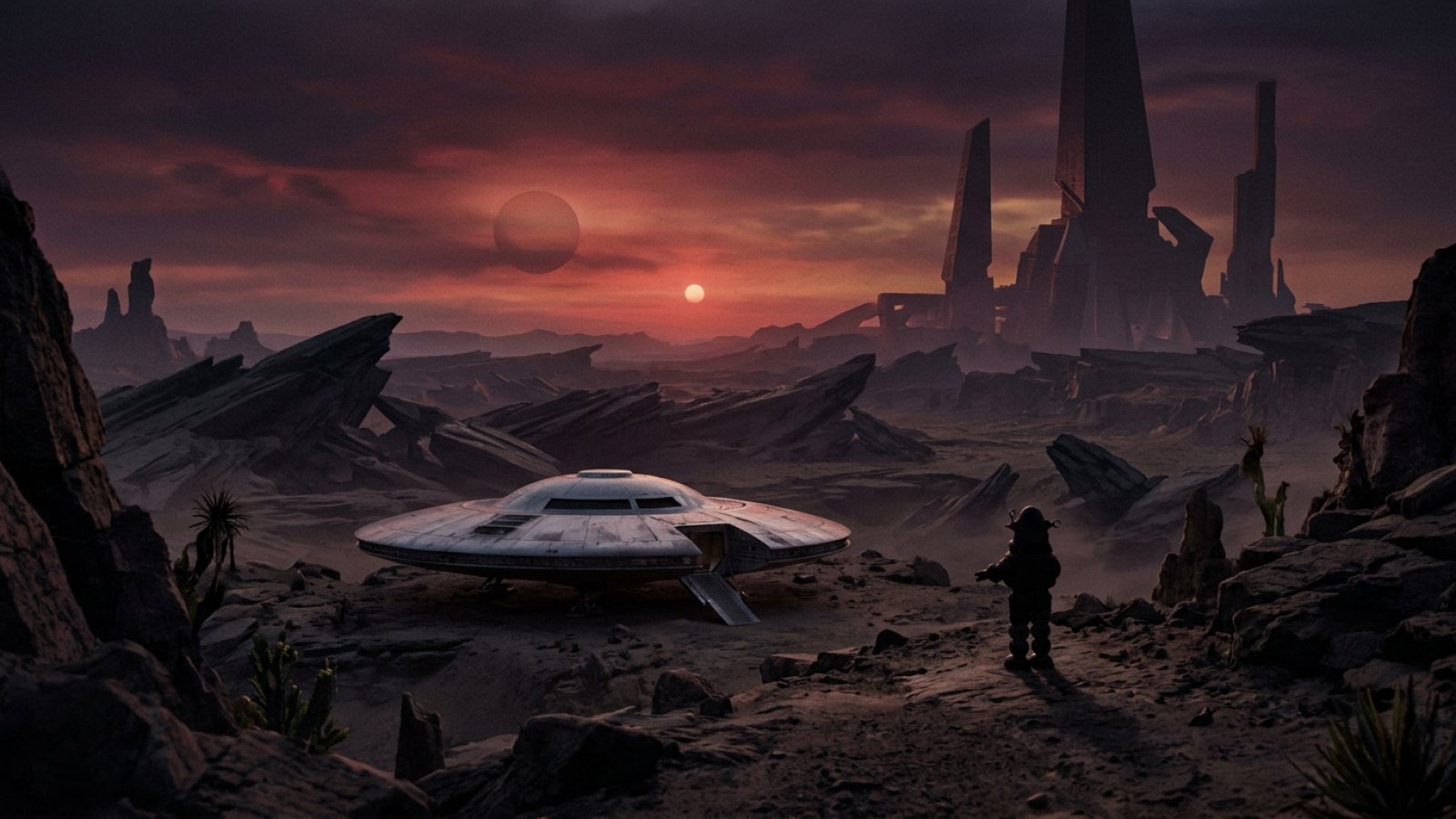
The hum of the C-57D cruiser, a constant, almost subliminal thrum, is as much a character in 1956’s Forbidden Planet as any of its human inhabitants. As the screen opens on an unblinking starfield, a voice introduces us to spacefaring men and their mission of mercy to the planet Altair IV. But the mission quickly turns to one of unsettling discovery. This wasn't just another bug-eyed monster romp, of which the mid-1950s offered a plentiful harvest; this was science fiction stepping into something grander, stranger, and far more psychological. In a decade marked by atomic anxieties and alien invasions born of Cold War paranoia, Forbidden Planet dared to ask what horrors lurked not from beyond the stars, but from within ourselves.
A Bard in the Asteroids
Fred M. Wilcox's direction brought to the screen a story that, despite its futuristic trappings, echoed a far older tale. The parallels to Shakespeare's The Tempest are unmistakable and deliberate: Dr. Morbius, the reclusive scientist on an isolated planet, mirrors Prospero; his beautiful, naive daughter Altaira, Miranda; the genial, endlessly resourceful Robby the Robot, an amiable Ariel. But the truly chilling analogue lies in the invisible, malevolent force that stalks the planet, a powerful entity of destruction, which functions as a primal, untamed Caliban. This creature, a "monster from the Id" as the film famously termed it, represented a groundbreaking shift. Instead of an external invader or radioactive mutation, the threat was internal, a manifestation of suppressed desires and unchecked subconscious power. This narrative depth elevated Forbidden Planet above the B-movie churn, inviting audiences to ponder the true nature of humanity's destructive potential, even with the most advanced technology.
The Sound of Tomorrow
Beyond its Freudian space opera, Forbidden Planet achieved another, equally revolutionary feat: it was the first film to feature an entirely electronic musical score. Credited as "electronic tonalities" by Louis and Bebe Barron, this groundbreaking sonic landscape was not composed in the traditional sense, but constructed with custom-built circuits and tape manipulations, creating abstract, often dissonant soundscapes that perfectly underscored the alien mystery of Altair IV. The Barrons' work eschewed orchestral conventions entirely, providing sounds that were organic yet synthetic, primal yet futuristic. The eerie thrum of the Krell machinery, the guttural snarls of the invisible monster, the gentle, otherworldly whispers of Altaira's garden – all were born from this electronic experimentation. It was a bold artistic choice that not only defined the film's unique atmosphere but also paved the way for decades of electronic music in cinema, from the synthesizers of Blade Runner (1982) to the digital sound design of contemporary blockbusters. It demonstrated that sound could be an active, unsettling narrative force, not merely a background accompaniment.
What Lingers in the Wreckage
Decades after its premiere, Forbidden Planet continues to cast a long shadow over science fiction. Its visual design – the sleek C-57D, the iconic Robby the Robot, and the colossal, enigmatic Krell underground complex – established archetypes that would be referenced and reimagined for generations. Robby, in particular, transcended the film, becoming one of cinema's most recognizable robots. But it is the film’s central thematic question that truly endures: what happens when humanity’s intellectual ambition outpaces its emotional and moral development? Morbius’s tragic flaw, his inability to control the dark aspects of his own subconscious, powered by a vanished super-civilization’s forgotten technology, speaks to a timeless fear. It’s a cautionary tale about power and responsibility, about the dangers of projecting our inner demons outwards, and about the inherent fragility of even the most advanced civilizations.
In a genre often focused on external threats, Forbidden Planet masterfully inverted the gaze, turning the telescope inward. It remains a potent reminder that the most terrifying monsters are often those we carry within ourselves, patiently awaiting the perfect technology to give them form. Its legacy is not just in its revolutionary sound or its enduring imagery, but in its audacious suggestion that science fiction could be a mirror, reflecting humanity's deepest truths and most dangerous flaws, a tradition that continues to be explored in science fiction today.
